
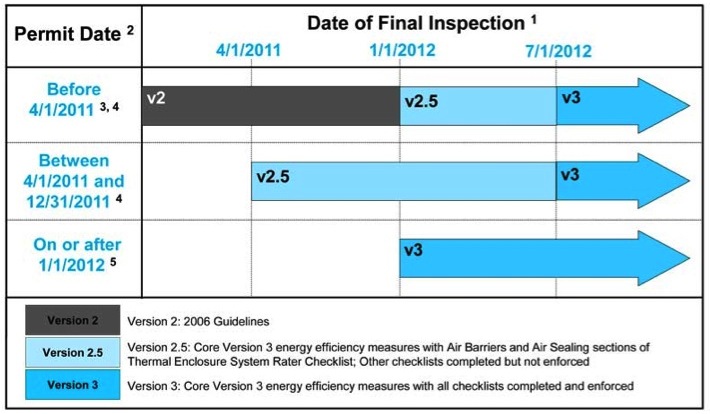
 Technically, ENERGY STAR Version 3 requirements will become mandatory January 1st, 2012, but the transition to this re-vamped program has already begun. This coming year, builders will be warming up with Version 2.5.
Homes under construction right now that aren’t expected to be finished before July of 2011, and any home permitted after April of 2011, will need to follow V2.5 guidelines. Homes that won’t finish before Jan 1, 2012 will need to be built to V3 standards. Although V2.5 will be a somewhat watered down version of V3, it’s going to be quite a bit more difficult than the current standards. I’ll explain the most significant changes in this article.
Energy Star V2.5 requires that all of the version 3 checklists are filled out, but very few of the items are mandatory. The items that are mandatory will make it much more difficult for some homes to qualify. The most significant changes in V2.5 are:
1. ENERGY STAR Reference Design Target – This target will replace the old HERS Index of 85 as the benchmark for what qualifies as ENERGY STAR. The Reference Design is calculated by creating an energy model of the rated home and comparing it to a home modeled with theoretical Perscriptive Path ENERGY STAR features. In other words, the HERS target is now variable and it’s also going to be more stringent. Homes will now need to be about 30% more efficient than code to qualify for the program, as opposed to 15%, which was the old target
2. Home Size Adjustment – In addition to the Reference Design, V2.3 and V3 require that the ENERGY STAR target also be adjusted according to a home’s size. Like the USGBC’s LEED, the adjustment is made according to the ratio of a homes square footage to its number of bedrooms. In other words, large homes with few bedrooms will incur a significant “penalty” and will need to meet a much more stringent target than a small home with the same number of bedrooms.
If the Brady Bunch built a 5000 square foot Energy Star home today, that included a bedroom for each family member and a guest bedroom for Alice, there would be no penalty. Now, let’s say that Mike and Carol Brady’s kids grow up and move away. They decide to build another home to retire in that is just a big, but doesn’t have as many bedrooms. They’ve ditched the extra bedrooms for office space, an exercise room and a bigger living room and kitchen, and have only included a master bedroom and two guest bedrooms in the plans. Let’s also say they started with a home that had a Reference Design (the new variable HERS index target) of 70. The home size adjuster will lower that target for house I just described by 13 additional “points.” The new target is now HERS Index 57. In other words, they need to make sure their home will be at least 43% more efficient than code to qualify for ENERGY STAR.
3. Additional Building Envelope Requirements – There are 3 significant changes to the old “thermal bypass checklist” (now called the “thermal enclosure checklist”). First, Builders must do one of the following: a.) install r-3 continuous rigid insulation board (in climate zone 4) in addition to standard cavity insulation; b.) build their house using SIP’s, ICF’s, or with double walls; or c.) include advanced framing such as 2-stud corners, insulated headers, minimally framed doors and windows, ladder T walls, and minimum stud spacing of 16″ (structural framing allowed to be more dense). Second, top plates must be air sealed, drywall gaskets must be installed, or spray foam must be installed at the roof deck. Third the entire slab edge must be insulated to r-5 (about 1″ or rigid foam). No exceptions.
To re-cap, qualifying for ENERGY STAR’s Version 2.5 will prove to be much more difficult than Version 2. Version 3 will be even difficult yet. Believe it or not, many raters aren’t happy with the changes. They think the new program guidelines are so difficult that many builders will drop out of the program, leaving the raters with no homes to certify. However, we think the program ought to be a challenging and think the new guidelines are a step in the right direction.