
 The available static pressure of your blower plays a huge role in making sure the HVAC system is able to perform optimally. After performing the Manual-J calculation, you know how many btu’s of energy will be required to keep each room of your home comfortable. This total btu requirement, or “load,” is used to select the equipment for the building. The size of the equipment is what determines the volume of air you’ll have to move through your system. This volume may be different for heating vs cooling, or it may be the same, depending on equipment type and the loads of the building. The equipment specifications will tell you how much air the system should move during heating and/or cooling modes for optimal performance.
Sometimes the blower that comes with the machine you’ve selected can achieve this desired airflow, and sometimes it can’t. It all depends on a few key variables:
- What is the blower’s “available static pressure” at the target airflow?
- What are the “components” that you have included in your system?
- What is the “effective length” of your duct system, as you have designed it?
These three variables, when combined, also enable us to determine the Friction Rate we’ll use to size our ductwork.
Determining What Available Static Pressure to Use as the Design Rate
The first thing to understand about available static pressure (ASP) is the relationship between ASP, system components, and the size of the ductwork. The following equation explains this relationship:
ASP – static pressure drop of system components = the static available for use on ductwork
The more static you have left over to spend on ductwork (ASPnet), the more likely it is that your blower will be able to move the desired amount of air. Your goal should be to have a lot of static left in your budget for use on the ductwork.
The ASP impacts the size of the ductwork. The less static you have available, the larger the ductwork will need to be. Large ductwork is expensive, takes up more space, and takes longer to install.
The ASP is listed on the blower chart, along with the airflow that the blower can deliver at the given static pressure. I like to think of the ASP as your static pressure “budget.” It’s important to be fiscally responsible when designing HVAC systems. Don’t spend more static than you have in your budget. If you do, you will end up with either low airflow (operating-point blower), excessive energy use (operating-range blower), or sometimes both (operating-range blower).
Components
The blower has to push and pull air through all of the components within the air distribution system. Some of these components are more restrictive than others. And, all of them have a negative effect on the ASP of the blower. Once we’ve subtracted out all of the associated static pressure losses from the components, we’re left with the ASPnet, which is what we get to spend on our ductwork.
When the manufacturer determines the ASP of a blower, they sometimes include the static drop of certain components in their equation. It is always important to read the footnotes. For example, it’s quite common for manufacturers to include the static loss associated with a filter of some type. You would want to find out which type of filter it is, and compare that to what you plan on using. Chances are, your filter will have a larger static drop than the one they included. So, you’ll need to adjust accordingly.
Coils
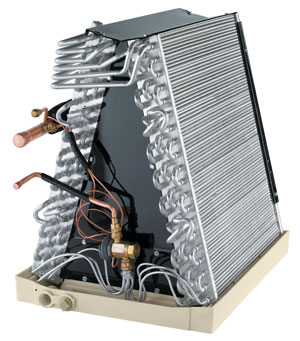
Another important point worth noting is the difference between fan-coil units and furnaces, when it comes to component losses. Fan-coils, as the name suggests, includes a fan and a coil. So, the ASP listed in their chart already incorporates the static drop of the coil.
A furnace, however, does not include a coil by default. The manufacturers know that contractors will want to put in different sizes of coils, depending on their need for cooling capacity. So, if you are using a furnace with an A/C coil, you’ll need to subtract the static drop of this coil from the ASP of the furnace blower. This alone will eat up 0.15-0.20 IWC of your ASP. You can see why it’s common to see blowers in furnaces operating at high static levels.
Filters
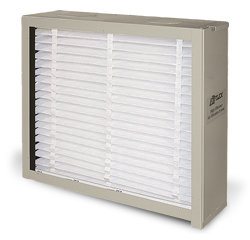
Aside from coils, filters generally consume the largest amount of ASP of all other components. Most of the time, the filter location was never designed to be the right size. You guessed it. They’re typically too small. As the chart below indicates, the more air we push through a filter, the higher the static drop is, exponentially! In the example below, if we had a system that was moving 1000cfm of air, and we were using the 16”x20” filter, we would have to subtract 0.24 IWC from our ASP. If, however, we used two filters, only moving 500cfm through each, with this same filter, we would only need to subtract 0.08 IWC from our ASP. This would give us more blower power to push the air through the ductwork, since we’re not spending it on the filters.
Terminations and Balancing Dampers
Manual-D suggests using 0.03 IWC for the supply register, the return grille, and the balancing damper. This corresponds with a velocity of about 700 fpm, which is the termination “not-to-exceed” limit for noise control. So, these three items would produce a total of 0.09 IWC of static that should be subtracted from the blower’s available static pressure.
Selecting Your Design ASP
When using an operating-range blower, the ASP selection process is a little different. You actually get to select it from the range of static pressures listed on the blower’s airflow chart. You’ll see that there’s a limit to the OR blower’s ability to fight against high static pressure. At some point, typically around 0.75 IWC, the airflow will begin to drop off, which may be below your desired airflow.
Manual-D recommends that you stay away from the “top-third” of a blower’s ASP range listed by the manufacturer. My real world recommendation is to choose the lowest ASP that you possibly can, typically between 0.50-0.75 IWC. After you lay out the ducts, fittings, and components, you can adjust your ASP until your FR is within the acceptable range.
2 thoughts on “Available Static Pressure and HVAC Equipment Selection”
my installer says static pressure of .65 is acceptable even though the air handler is tested at .50. should I have this addressed?
Hi Don,
I’d tend to agree with your installer, as long as the “right” amount of air is moving through the system at that pressure. For instance, if your blower should be moving 1000cfm through the system, your installer would want to verify (by looking at the blower chart) that at the static pressure of 0.65″ and the corresponding blower speed (medium, high, low, etc.), the blower can move 1000cfm.
Isaac