
 Now that spray-foam insulation is becoming more common in western North Carolina’s buildings, I figure it’s time once again to discuss the most common question out there – “What’s the difference between open-cell (low-density) and closed-cell (high density) foam?” As with any material selected for the building envelope assembly (sheathing, drainage plane, cladding, etc.), one should consider how it affects the flow of air, heat, and moisture, as these are the core elements that are controlled by the building’s exterior envelope.
Let’s look at both types of foam (open-cell and closed-cell) with respect to air, heat, and moisture:
Air: Both types are air-barriers. When installed properly (very important for proper performance) foam expands and seals the smallest of cracks and gaps within the exterior shell of the building. This keeps the outdoor air from being able to access the inside of the wall assembly. This not only increases the efficiency of the building envelope, but also controls moisture migration and build-up within the walls. If outdoor air can get into the wall assembly, then it becomes nearly impossible to control condensation within the cavity. Lack of moisturecontrol and increase in moisture risk is obviously not the ideal scenario when it comes to airflow.
Heat: The fundamental rule of heat conduction is: The amount of heat that flows through a material is directly proportional to the temperature difference across that material. So, the larger the temperature difference, the more heat transfer, and therefore… it’s best to have more R-value where the difference is the greatest.
Due to the higher density of closed-cell foam, it has a higher R-value per inch of thickness than the open-cell foam. Generally speaking, closed-cell foams range from R-6 to R-6.9 when they are initially installed. Over time, some of these foams will actually lose a little R-value (a result of off-gassing process) and settle out around an R-4.5.
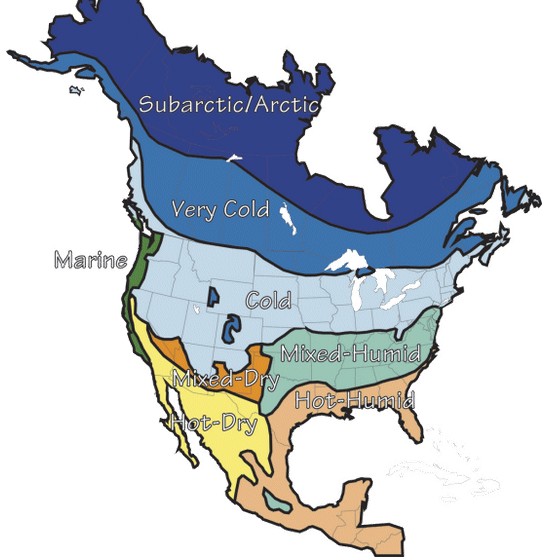 Even though there is a difference in R-value per inch, I rarely see a building that can’t be properly insulated (speaking only to R-values) with either type. In this climate, we generally don’t install much more than an R-19 in the exterior walls. The temperature difference across this assembly is the greatest in the winter time, generally around 40-45 degrees. This would equate to about 3” of closed-cell foam and about 5.25” of open-cell foam. These R-values can be achieved with either foam type when using 2×6 framing. At the roof deck, typical temperature differences in the summer months are around 80-90 degrees – twice that of the walls. This is why local building codes require an R-38 insulation value at this surface. The extra insulation on this surface reduces the amount of heat that comes through to the living space, thus reducing the cooling load in the building. This can typically be achieved with either foam type as well. This would equate to ~6.5” of closed-cell foam and ~10.5” of open-cell foam. So, as long as your building has adequate space between the roof deck and the ceiling, the suggested R-values on the roof deck can be achieved with either type.
Moisture: Moisture, as you know, is what causes the majority of building failures. It’s what causes wood-rot, enables mold growth, attracts termites, and supports the life of dust mites. When it comes to moisture, it’s best to do it right the first time, because you only get one chance. With respect to the two types of foam, they handle moisture very differently. Open-cell foams allow vapor to diffuse through them at ~5 times the rate of closed-cell foams. So, you could say that they “breathe” more easily (vapor, not air) than do closed-cell foams.
In this region, the majority of our buildings are constructed with wood. They’re framed with wood and sheathed with wood. As mentioned earlier, we want wood to stay dry. More importantly, if for some reason the wood were to get wet (because IT does happen), we want it to dry out as quickly as possible. By allowing our wooden buildings to dry, we increase their durability (Wet buildings don’t tend to last too long). As stated by Joe Lstiburek, a world renowned building scientist, “A durable and healthy building must balance the wetting that inevitably occurs with the same amount of drying to avoid accumulation and certain failure over time.”
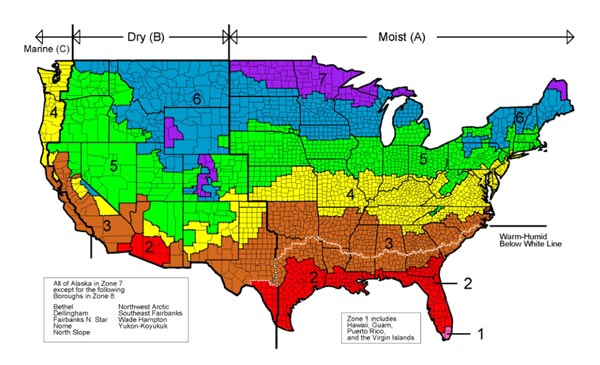
Now consider the location of foam insulation, as it relates to moisture control. Foam, just like any other insulation type, is installed on the inside edge of the exterior sheathing (walls and/or roof). Due to being “behind” the wood, it can do nothing to prevent it from getting wet to begin with. Keeping the water off of the wood is the job of the exterior cladding and the drainage plane system, not the insulation (Think windshield wipers on the inside of your windshield!?!). Since the location of insulation is down-stream from the primary moisture drive (outside to inside), then we should select a material that will allow that wood to dry as quickly as possible should it ever get wet… assuming the goal is to create the most durable wall assembly possible (one would hope). It is important to note that in zones 5 and higher, building code requires a vapor retarder on the inside of the envelope to reduce vapor driven moisture migrating into the assembly. In zones 4 and lower, this is not required.
No matter how hard we try, the roof will one day leak and the window flashing will one day fail. Both foam types provide an air-seal and the proper amount of R-value. But they behave quite differently when it comes to the M word – MOISTURE. Open-cell foam allows vapor to diffuse – closed-cell seriously impairs the process.
Basing decisions on solid and knowledgeable building science makes good sense AND good business. How you design and manage the flow of air, heat and moisture into, around and through the building assembly will make the difference between a satisfied client or a future of call-backs and problems.