
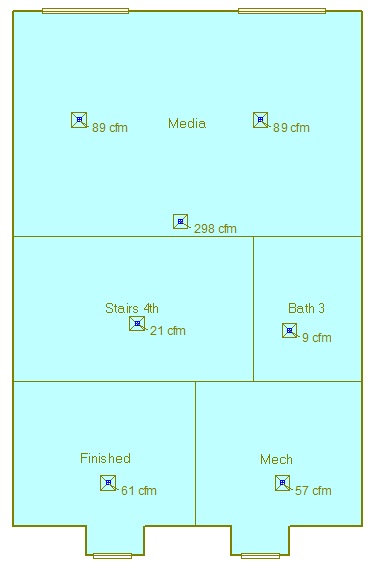
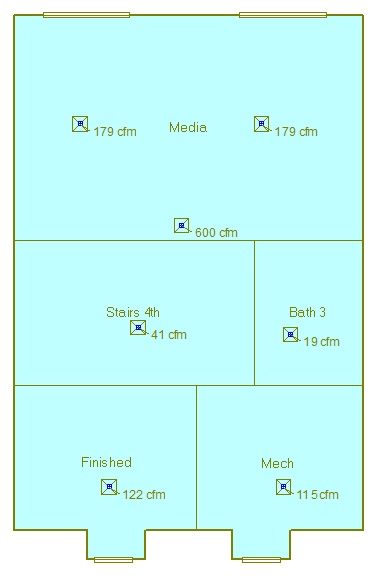
If you’re installing an HVAC system based on Manual-J sizing calculations, how do you know what size the ducts need to be for each room? Hopefully, you said “I’d use ACCA’s Manual-D, of course.” Assuming that was indeed your response, give yourself a pat on the back, and let’s move on. Take a look at the two images below. They are both showing the 3rd floor of a townhome, with a very small footprint. There is a system in the lower portion that handles floors 1 & 2. This floor will need it’s own system. Which airflow numbers should we use when sizing our ductwork?
How would these two versions affect your ability to:
- Select correct duct sizes?
- Size jumper-ducts or transfer grilles?
- Control noise?
- Achieve proper airflow across the coil with a fixed-speed blower?
We need to ask ourselves what we’re actually going to do with the Manual-J that’s being produced. If it’s simply to appease a code requirement, and it won’t be used for sizing the ductwork, then none of this really matters (and shame on you for guessing your duct sizes). But, if you ARE going to use the Manual-J outputs to select a properly sized unit and then size the ducts accordingly, you’ll need to make sure you’re using the right numbers!
For example: Let’s look at the house shown in the two photos above. The house is well insulated, and the load up there is pretty small on this upper level. The Manual-J software says that you’ll only need a total of 298 CFM (the one that says 298 is a return – one slash) to maintain the indoor design conditions. Chances are, you’ll be installing a 1.5-ton system up there, because that’s the smallest split-system made that is reasonably priced. In this scenario, you’d want to make sure your ductwork is sized to move 600 CFM, not 298. Notice that the software splits up the “extra” air proportionally for this level. Now, instead of the Media room requiring two ducts that deliver 178 cfm total, it actually needs two (or more) ducts that each deliver a total of 358 cfm. That’s twice as much air! You’d obviously want larger ducts to move all of this extra air. Otherwise, you’d be choking your system and never achieve the advertised efficiency.
Let’s say that this house is an ENERGY STAR Version 3 house, and it has to have a “balancing report” completed for the certification. Your balancing target numbers should reflect the 600 cfm number, not the 298 cfm. Transfer grilles should be sized with the larger numbers as well. Airflow to each room is supposed to be within 25 cfm or 20% of the Manual-J requirement, whichever is greater. If you’re supplying twice as much air to each room, that’s way beyond the 20%. So, be sure to use your adjusted target airflows, based on the capacity of your blower.
Most software programs allow you to go in and override the CFM of the systems before printing the load reports. This is really handy, because it will split up the total amount of air in a balanced fashion throughout the zone being served by the system!
Need professional Manual-J calculations completed for your project? We work with Architects, Builders, and HVAC contractors. Get in touch with us, or place an order online!