
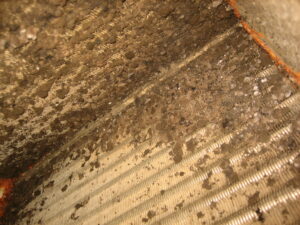
 Mold is good… except when it’s growing inside your house. Without mold, decomposition would not occur, cheese would be boring, and the majority of houses in western North Carolina would be missing the musty smell that wafts up from the crawlspace via the ductwork every time the air turns on.
Mold is what makes nature’s cycle complete. The role of mold is to break down the energy in plants/cellulose so that it can return to the earth, beginning its cycle all over again.
Our society has decided that it makes good sense to build our houses out of trees. We frame them with sticks of wood, sheath them with plywood and OSB (shredded wood mixed with glue + heat), and finish off the inside with sheetrock (hopefully not from China) that is faced with paper on both sides. Even though we live in houses made of mold food, mold food is only appetizing when moisture levels are out of balance. Since we can’t easily eliminate mold food from our houses, it becomes very important that we keep them dry.
There are three main sources of moisture introduction in a house: plumbing leaks, water from outside, and moisture produced inside the home.
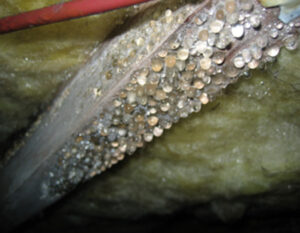 Plumbing leaks are typically a result of freezing.
The only way a pipe can freeze in a house is if it’s located in an exterior wall cavity that is poorly insulated or in a cavity that is connected to outdoor air via breaks in the air-barrier. When planning the location of plumbing, consider the temperature of the cavity where the pipes are located. Interior walls and well-sealed floor cavities are the best options. When positioning water heaters or air-handlers on upper levels, include drain pans beneath them to prevent damage should (when is more realistic) a leak occur(s).
“Outside” moisture comes from the sky, from the ground, and from the air.
Water from the sky should go exactly where you want it to go – away from your house. Leaky roofs/flashing details, negative slopes around the house (land sloping toward your house), missing drainage planes between the sheathing and the siding, and non-functioning gutters are typical “sky water” problems seen in the field.
Water from the ground should also be managed by design. The lack of vapor control systems in the crawlspace and poor (or non-existent) exterior foundation drainage systems are common “ground water” intrusion problems.
The most mysterious of the three is moisture from the air – vapor. Vapor gets into the home via air leakage or by diffusing through each material that composes your building envelope (walls/roof/floor). Air leakage transports about 100 times the amount of moisture from outside to inside than does the natural diffusion of vapor through the materials in the wall. So, if you’re concerned about moisture, you need to control the air leakage.
Outside air that leaks into your home through the building envelope carries moisture into these cavities. If these cavities contain wood, darkness, and the right temperature range, you have perfect conditions for mold growth. In the summertime, outside vapor wants to move into the house (moves from high levels to low levels). In the wintertime, the opposite is true. So, the likelihood of mold growth is pretty high when outdoor air can leak into the wall cavities and condense on the back of a cold piece of sheetrock (air conditioned house) that is lined with paper. This is also a problem if there is a layer of plastic between the sheetrock and the studs. Now, the condensation will drip down the plastic and settle in the bottom of the wall. The same can be said in the winter. But, the cold surface is the outer surface of the house – the sheathing. The only way to control this air-transported vapor is to seal the holes in your walls which, like most things, is easier to do while the house is being built.
To battle outdoor moisture, the house should be as air-tight as possible and be designed to shed water. There are many materials and systems that play a part in the control of moisture. There are exotic materials that are simple to install while there are simple materials that require more careful installation. Either route will work, as long as the building envelope is functioning as a system. Investing more energy/money in controlling moisture within the building envelope will be well worth the effort in the long run.
 Moisture produced inside the house should be removed with proper use of bathroom/kitchen exhaust fans. It is imperative that these ducts take the exhausted air all the way to the outside, not just into the attic. It is also important that the ductwork on these fans be as short as possible with very few bends. If you cannot avoid a long duct run, get a larger fan or install a booster fan to compensate for the added static pressure.
Oversized air conditioners (A/C) are also quite common and can create high moisture levels inside the home. First, understand that an A/C’s role is to cool AND dehumidify. When an A/C unit is too large, it satisfies the temperature demand of the thermostat before it has the chance to remove enough moisture to make the house comfortable (this requires longer run times). All you’re left with in this scenario is cool/sticky air, high moisture levels, and lots of cold surfaces. Remember, bigger is not always better.
What size is the right size? A “Manual-J” calculation can be done to determine the proper sized machinery for your specific house. This calculation is generated by using a sophisticated computer software program, which takes many different variables into account, all of which are specific to your house. This report not only tells you how big the overall system should be, but also how much air to inject into each room of the house for optimum comfort.
No one wants a rotting house that stinks of mold. A true sign of a quality house is one that handles moisture properly. Whether you’re trying to improve your property or building a new home, focusing on moisture control should be a top priority for your health and your wallet.